How to Choose the Right Interior Design Firm in UAE: A Luxury Homeowner’s Checklist
Selecting an interior design Dubai firm for a high-value residential project demands rigorous vetting beyond portfolio aesthetics. The UAE’s luxury real estate market—where average villa prices in Emirates Hills exceed AED 25 million and penthouse renovations in Downtown Dubai routinely surpass AED 5 million—requires design partners capable of managing complex supply chains, coordinating multinational contractor teams, and delivering precision execution within compressed 12-18 month timelines. This checklist provides data-driven criteria for evaluating firms against measurable performance indicators, project management capabilities, and technical expertise specific to UAE construction standards and luxury client expectations.
Verifying Credentials and Market Position
Begin with quantifiable track records. Request completion statistics for projects within your property category: villas between 10,000-30,000 square feet, penthouses above 5,000 square feet, or palace-scale residences exceeding 50,000 square feet. Firms operating at the luxury tier typically maintain portfolios of 15-25 completed high-net-worth projects annually, with individual project values ranging from AED 3 million to AED 50 million. Antonovich Design, for instance, has executed over 400 luxury residential projects across the GCC since 2003, establishing benchmarks for timeline adherence and budget management in the ultra-high-end segment.
Examine regulatory compliance documentation. UAE-based firms must hold valid KHDA or DED business licenses, professional indemnity insurance with minimum coverage of AED 5 million, and contractor coordination certifications. For projects in Dubai, verify membership with organizations such as the Dubai Design District (d3) or recognition by Dubai Municipality’s architectural review boards. International firms operating in the UAE should demonstrate local partner relationships and familiarity with Civil Defence fire safety codes, DEWA electrical standards, and municipality-specific approval processes that can add 6-12 weeks to project timelines if mishandled.
Evaluating Technical Capabilities and Specializations
Luxury interior execution requires specialized technical knowledge distinct from mid-market residential design. Assess firms based on demonstrable expertise in critical areas:
| Technical Domain | Required Capability | Verification Method |
|---|---|---|
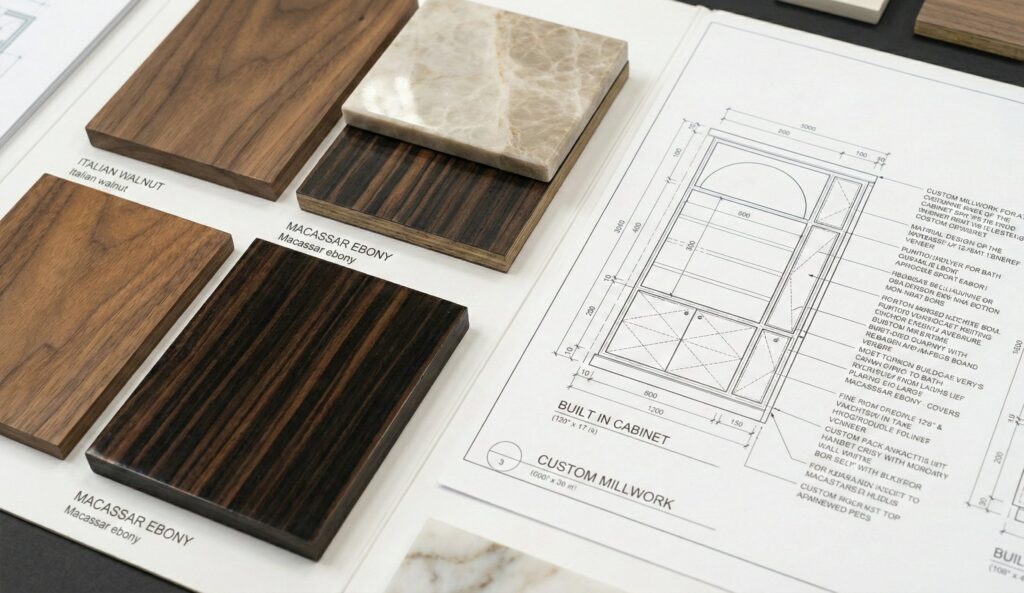
| Custom Millwork | In-house joinery specifications for Italian walnut, macassar ebony, burl wood with tolerance margins under 0.5mm | Request CAD drawings and material sourcing documentation from recent projects |
| Lighting Design | Photometric analysis, lumen calculations, integration of smart systems (Lutron, Crestron) with 3000K-6500K temperature range control | Review lighting plans with fixture specifications and control system schematics |
| Marble/Stone Procurement | Direct quarry relationships in Italy, Turkey, Portugal; book-matching coordination for slabs; Mohs hardness suitability analysis | Examine supplier contracts and installation case studies showing vein continuity |
| MEP Coordination | Integration planning for HVAC, plumbing, electrical with concealed access panels; BMS system specifications | Request MEP coordination drawings and system integration timelines |
Firms lacking direct relationships with European manufacturers and Middle Eastern craftsmen typically face 15-30% cost premiums and 4-8 week delivery delays when sourcing specialty materials. Verify whether the firm maintains stock relationships with brands like Fendi Casa, Armani Casa, or Bentley Home, which require minimum order commitments and advance booking for custom pieces.
Assessing Project Management Infrastructure
Execution capability separates competent designers from reliable luxury partners. Evaluate organizational structure through specific metrics. Top-tier firms assign dedicated project managers with construction management certifications (PMP, PRINCE2) who oversee 3-5 concurrent projects maximum, ensuring weekly on-site presence and real-time issue resolution. Request organizational charts showing team allocation: design lead, technical architect, procurement specialist, site supervisor, and quality control inspector—typically a 6-8 person team for projects exceeding AED 8 million.
Examine project management software and communication protocols. Professional firms utilize platforms like Procore, Buildertrend, or Aconex for documentation management, RFI tracking, and change order processing. Request sample project dashboards showing milestone tracking, budget variance reporting, and vendor payment schedules. Firms using manual spreadsheets or email-based coordination demonstrate inadequate infrastructure for complex luxury builds where a single marble installation might involve 12 separate vendors and require 6-week lead times.
Analyze historical performance data. Request completion metrics for the past 24 months: percentage of projects delivered within contracted timelines, average budget variance (top firms maintain variance under 8%), client approval rates for design revisions, and defect resolution times post-handover. Antonovich Design’s reported 94% on-time delivery rate and average budget variance of 5.7% reflect the operational rigor expected in the luxury segment.
Reviewing Design Process and Client Involvement
Luxury clients require structured input opportunities without derailing project momentum. Evaluate firms on their phase-gate approach with defined approval checkpoints:
- Concept Phase (Weeks 1-4): Initial design direction, mood boards, 2-3 stylistic options with 3D renderings at 50% detail level. Expect 2-3 revision rounds.
- Design Development (Weeks 5-10): Detailed floor plans, elevations, material selections with physical samples, furniture specifications. Single revision round with itemized change impact analysis.
- Documentation Phase (Weeks 11-14): Construction drawings, MEP coordination, procurement schedules, contractor bid packages. No aesthetic revisions; technical clarifications only.
- Execution Phase (Months 4-18): Weekly progress reports, monthly site meetings, real-time issue escalation protocols.

Firms lacking structured approval gates create scope creep, with mid-project design changes adding 15-40% to original budgets and extending timelines by 3-6 months. Request sample project schedules showing approval milestones, client decision deadlines, and revision policies. Professional firms charge 12-18% fees for post-approval changes during construction, incentivizing timely decision-making.
Analyzing Cost Structures and Transparency
Luxury interior pricing in the UAE follows distinct models. Fixed-fee arrangements (typically 15-25% of total project cost) suit clients preferring predictable budgets but require comprehensive initial specifications. Cost-plus structures (designer fee plus itemized vendor markups of 20-35%) provide flexibility but demand rigorous invoice documentation. Time-and-materials approaches suit phased renovations but lack cost certainty.
Demand granular budget breakdowns showing allocation across categories:
| Category | Typical % of Total Budget | Verification Points |
|---|---|---|
| Custom Furniture/Millwork | 25-35% | Itemized quotes from fabricators, material specifications, delivery terms |
| Marble/Stone | 15-22% | Slab selection documentation, installation labor breakdown, waste factors (typically 20-25%) |
| Lighting/Electrical | 10-15% | Fixture specifications, control system costs, installation labor |
| Soft Furnishings | 12-18% | Fabric selections, custom upholstery quotes, window treatment fabrication |
| Art/Accessories | 8-12% | Procurement documentation, authentication certificates, installation hardware |
| Contractor Labor | 18-25% | Trade-specific breakdown, man-hour estimates, supervision costs |
Reputable firms provide monthly budget reconciliation reports comparing projected versus actual spending with variance explanations. Avoid firms offering vague “all-inclusive” pricing without detailed line items—this approach conceals markup structures and limits cost control.
Investigating Supply Chain and Vendor Networks
Material quality and delivery reliability depend on established vendor relationships. Top firms maintain direct accounts with 50-100 specialty suppliers across furniture, fabrics, stone, lighting, and hardware categories. Request vendor lists with relationship duration and annual transaction volumes. Firms ordering through third-party distributors rather than direct manufacturer relationships typically add 20-30% cost premiums and face longer lead times.
For international sourcing, verify logistics capabilities. European furniture shipments to Dubai require 8-12 weeks including production, shipping, customs clearance, and final delivery. Firms lacking dedicated freight forwarding relationships encounter delays at Jebel Ali Port, where luxury goods require detailed documentation and face 5% import duties plus VAT. Ask about contingency planning for damaged shipments, customs holds, or production delays—professional firms maintain buffer inventory and alternative vendor options.
Examine local craftsman networks for onsite custom work. Premium firms employ or contract directly with specialized trades: Italian stucco artisans for decorative plasterwork, Lebanese mosaic craftsmen for intricate stone installations, Pakistani master carpenters for carved wood details. Third-party subcontracting through general contractors reduces quality control and adds 15-25% coordination overhead.
Confirming Post-Completion Support and Warranties
Luxury projects require extended post-occupancy support. Standard practice includes 12-month defect liability periods covering workmanship issues, material failures, and system malfunctions. Request warranty documentation specifying coverage terms: furniture structural warranties (typically 5-10 years), marble installation guarantees (3-5 years), lighting fixture coverage (2-3 years based on manufacturer terms), and custom millwork (5-7 years for joinery, 2-3 years for finishes).
Evaluate maintenance service offerings. Antonovich Design and comparable firms provide annual maintenance packages including marble resealing, wood refinishing, upholstery cleaning, and hardware adjustments—essential for preserving assets in Dubai’s harsh climate where humidity and temperature fluctuations accelerate material degradation. Request sample maintenance schedules and service response times (premium firms commit to 48-72 hour response for urgent issues).
Clarify punch list procedures. Professional firms conduct three-phase inspections: pre-handover (identifying defects before client occupancy), handover walkthrough (comprehensive review with client), and 30-day post-occupancy follow-up. Request historical punch list data showing average item counts (well-managed projects typically close with under 50 minor items) and resolution timelines.
Conducting Reference Checks and Site Visits
Portfolio photography rarely captures execution quality or client satisfaction. Request contact information for 5-7 recent clients with projects similar in scope, budget, and property type. During reference calls, focus on specific performance questions: timeline accuracy, budget management, problem-solving during unexpected issues, communication responsiveness, and post-completion support quality. Ask about challenges encountered and how the firm resolved them—responses reveal problem-solving capabilities and accountability.
Arrange visits to 2-3 completed projects within the past 18 months. Examine details indicating craftsmanship quality: door and drawer alignment (gaps should not exceed 2mm), marble vein matching at seams, paint finish consistency under varied lighting, hardware operation smoothness, and electrical fixture integration. Check concealed areas like closet interiors, service corridors, and mechanical spaces—firms cutting corners sacrifice quality in non-visible zones.
Review project archives. Request complete documentation from a comparable completed project: initial design presentations, approval correspondence, construction drawings, change order log, budget tracking reports, and final punch list. This documentation reveals organizational rigor, communication clarity, and change management processes that determine project success beyond design aesthetics.
Making the Final Selection
Synthesize evaluation data across seven decision factors, weighted by project priorities:
- Technical Expertise (25%): Demonstrated capability in required specializations, vendor relationships, material knowledge
- Project Management (20%): Organizational infrastructure, software systems, team allocation, historical performance metrics
- Design Alignment (18%): Portfolio relevance, aesthetic compatibility, creative approach to your specific requirements
- Cost Transparency (15%): Detailed budgeting, clear fee structures, markup disclosure, value engineering capabilities
- Communication Systems (12%): Approval processes, reporting frequency, escalation protocols, client accessibility
- Reference Validation (10%): Client satisfaction data, repeat business rate, problem resolution track record
Create a scoring matrix assigning 1-10 ratings for each firm across these factors. Multiply by weights and total scores. Firms scoring below 7.5 lack sufficient capability for luxury execution. Those scoring 8.0-8.5 represent competent choices. Scores above 8.5 indicate exceptional partners worthy of premium fees. Combine quantitative assessment with qualitative factors: personal rapport with the design team, alignment on project vision, and confidence in their ability to navigate the inevitable challenges of complex residential construction.
Request final proposals including detailed scope definitions, fee structures, project timelines with milestone dates, team assignments, and contract terms. Review contracts with legal counsel, ensuring inclusion of performance guarantees, payment schedules tied to milestone completion, intellectual property rights, dispute resolution procedures, and termination clauses. The right interior design firm becomes a trusted partner managing millions in assets and delivering spaces that function flawlessly for decades—selecting based on comprehensive due diligence rather than portfolio aesthetics alone protects your investment and ensures successful outcomes.